
-30%
Jamaican Black Castor Oil



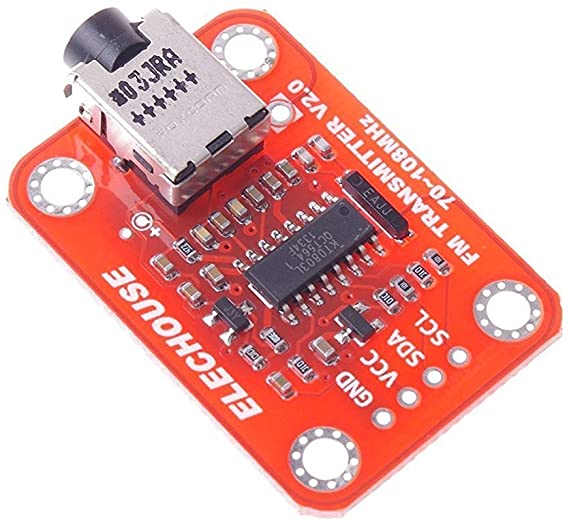
DescriptionWireless audio does not always require complex Bluetooth pairings or proprietary receivers. The Elechouse V2.0 FM Transmitter Module leverages the universal FM radio band to transmit your custom audio to car stereos, portable boomboxes, and home theater receivers. Whether you are building a drive-in movie theater audio system, a wireless tour-guide microphone setup, or just broadcasting your own playlist around the house, this module makes RF transmission remarkably simple.Digital I2C Tuning (The KT0803L Advantage)Older, cheaper FM transmitters rely on a tiny mechanical potentiometer to change the frequency, which often drifts out of tune as the room temperature changes. This V2.0 module is built around the modern KT0803L silicon chip. Instead of turning a dial, you connect the SDA and SCL pins to your Arduino, Raspberry Pi, or ESP32. Using standard I2C libraries, you simply type the exact frequency you want to broadcast on (e.g., 102.5MHz) into your code, and the chip locks onto it digitally with crystal-clear stability.Plug-and-Play Audio InputThe board features a heavy-duty Foxconn 3.5mm stereo audio jack. You do not need to strip wires or solder audio lines; simply plug a standard AUX cable from your smartphone, laptop, or DFPlayer Mini audio module directly into the board to start feeding it an audio signal.Antenna Design (Crucial Setup Note)To actually transmit the signal through the air, you need an antenna. You will notice a small solder hole on the PCB specifically marked for the antenna. For basic room-scale broadcasting, simply soldering a ~75cm piece of standard wire to this pad acts as a quarter-wave antenna, providing excellent range and signal clarity.Key Features:Wide Broadcast Range: Supports both the standard FM band (88-108MHz) and extended frequencies down to 70MHz.Software Controlled: No drifting frequencies; tune your station via precision I2C digital commands.Integrated Audio Jack: Standard 3.5mm socket makes connecting audio sources completely foolproof.Logic Level Compatible: Operates safely on both 3.3V and 5V logic systems without the need for external level shifters.Technical Specifications:Operating Voltage (VCC): 3.0V to 5.0V DCCommunication Interface: I2C (Address usually 0x3E)Frequency Range: 70 MHz to 108 MHzTransmission Range: Varies heavily by antenna and power supply (typically 10 to 50 meters indoors)Audio Format: StereoDimensions: ~36mm x 25mmIdeal Applications:Custom MP3 players that broadcast to car stereosWireless audio links for haunted houses and interactive art installationsDIY baby monitors or room-listening devicesEducational projects exploring RF transmission and I2C communicationGetting started with FM transmitter Module V2.0In this Tutorial we are going to see how we can transmit our voice or audio music so that someone who have a radio receiver can receive that voice or music, simply we are going to make a simple FM radio station, whereby we are going to interface the FM transmitter Module V2 or V1 with Arduino UNOStep1: Hardware requiredthe following are materials needed to finish our task:Arduino UNOFM transmitter module(V1 or V2 by elechouse)Jumper wiresUploading the sample sketch#include <FMTX.h> float fm_freq = 90; // Here set the default FM frequency void setup(void) { Serial.begin(9600); Serial.print("FM-TX Demo\r\n"); /** Initial, set FM channel and select your area: USA EUROPE JAPAN AUSTRALIA CHINA */ fmtx_init(fm_freq, USA); Serial.print("Channel:"); Serial.print(fm_freq, 1); Serial.println("MHz"); } void loop(void) { /** check for data setting new frequency. Users could input data from Serial monitor. Data must start with '&' and followed by 4 numbers, such as &8000. The first two is the integer part of new frequency (Unit: MHz), and the last one is the decimal part. And the channel must between 70MHz and 108Mhz. For example, &756 is 75.6MHz, and &666 is out of range. */ if(Serial.available()){ switch(Serial.read()){ case '&': u8 i,buf[4]; float ch; i=0; delay(30); while(Serial.available()&&i<4){ buf[i]=Serial.read(); if (buf[i]<= '9' && buf[i]>= '0') { i ;} else{ i=0; break; } } if (i==4){ ch = (buf[0]-'0')100 (buf[1]-'0')*10 (buf[2]-'0')*1 0.1(buf[3]-'0'); if(ch>=70&&ch<=108){ Serial.print("New Channel:"); Serial.print(ch, 1); Serial.println("MHz"); fmtx_set_freq(ch); }else{ Serial.println("ERROR:Channel must be range from 70Mhz to 108Mhz."); } }else{ Serial.println("ERROR:Input Format Error."); } while(Serial.available()){ Serial.read(); } break; } } }